Aircraft Detailing at Florence Peretola (LIRQ)
Cabin resets, dry wash and complete details on stand for super-midsize to ultra-long-range jets.
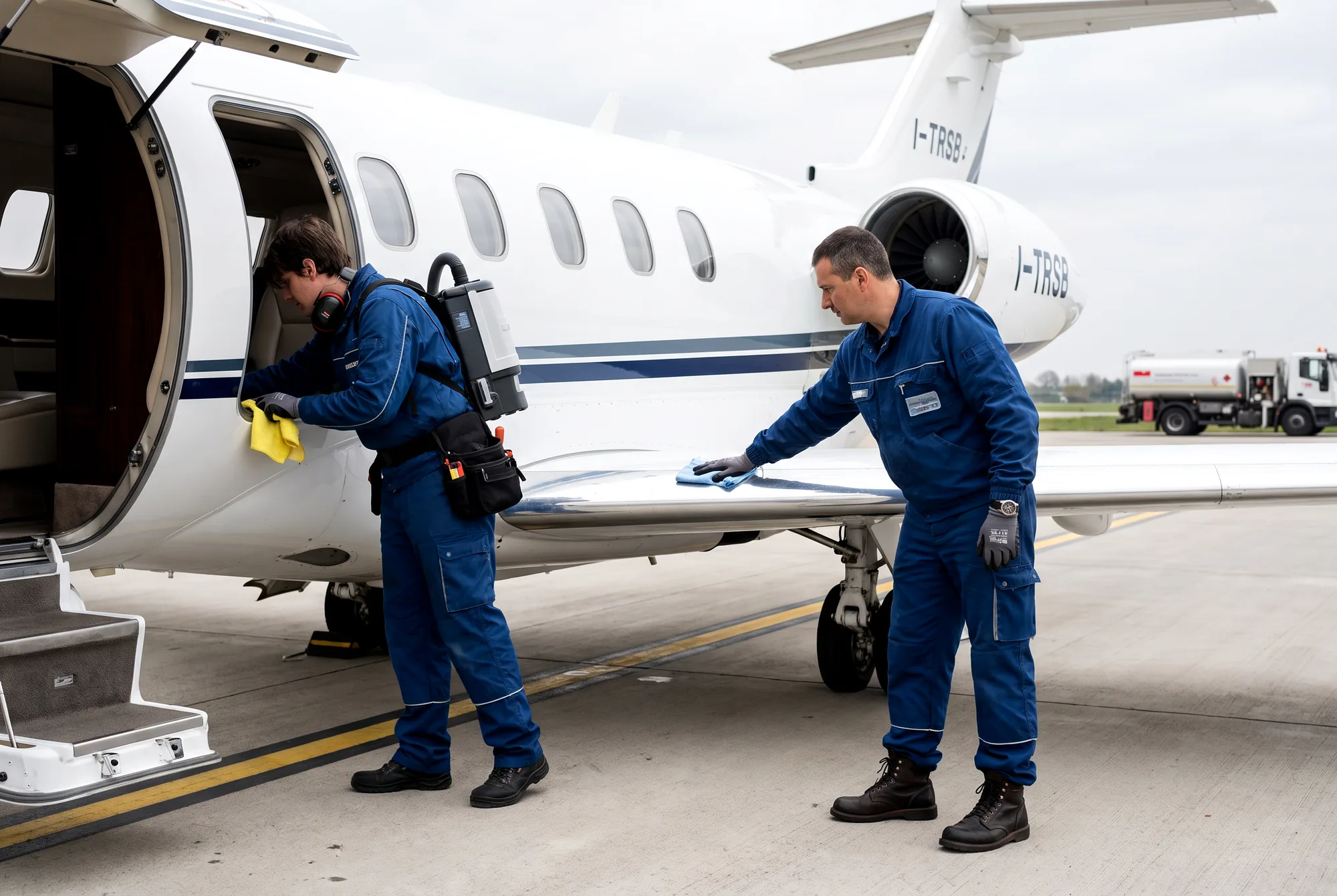
Aircraft Detailing at Florence Peretola serves chief pilots, charter operators and FBO managers moving business jets through one of Tuscany's busiest city airports. Whether you need a quick turn between legs, a full interior detail during a longer ground stop or a complete exterior and brightwork package while the aircraft is based here, we work within the slot-coordinated rhythm of LIRQ and the apron procedures set by each handling agent. Every service closes with a written report and time-stamped photographs delivered before you sign the tech log, so both flight crew and the home office have a record of the work performed on stand.


05/23 · 1560 m
AIP and airport data142 ft
5 km
Florence city centre (north-west)3 on the airport
independent, no affiliationWhat changes at Florence Peretola?
The airport sits at 142 feet elevation, five kilometres north-west of Florence city centre. A single 1,560-metre runway with displaced thresholds handles all movements, and the field is slot-coordinated; PPR and advance notice to the handler are essential. Four handling agents operate at the airport—Signature Aviation (Signature Florence), Sky Services, AviaVIP (Argos VIP Private Handling) and Toscana Aeroporti Handling, the same operator that runs Pisa—and each has its own apron procedures, GPU availability and escort requirements for third-party crews.
The short runway and displaced thresholds mean careful MTOW planning for departures, particularly in summer when density altitude rises. Slot discipline is tight, so a quick turn or exterior dry wash must fit the window between block-in and your next departure clearance. If you are holding for weather or positioning the aircraft here between legs, a full interior detail or brightwork polish becomes practical; we coordinate directly with your handler to confirm stand time, power and water access, then schedule the crew accordingly.
How do you document the work at LIRQ?
Every service closes with a written report and a set of time-stamped photographs taken on the apron before we leave the stand. The report lists the products used, the areas covered, any deferred items—a scuffed threshold plate, a stain that needs a second pass, a static port we masked and left untouched—and the names of the technicians who performed the work. Photographs show the cabin before we start, key stages during the detail and the finished result, so both the flight crew signing the tech log and the director of maintenance reviewing the file back home have a complete record.
For recurring work—monthly interiors under a fleet-care programme, quarterly brightwork polish, a standing quick-turn order each time the aircraft overnights at Florence—the documentation becomes a trend log. You can see whether a particular seat is wearing faster than the others, whether the galley vinyl is holding up to the decon schedule, whether the leading-edge polish interval needs to be shortened. That record also satisfies any charter-audit or management-company requirement for third-party service traceability, and it gives the captain confidence that the same standard was met on stand even when the usual crew was not there to watch.
Which services fit between legs at Florence?
A quick turn—cabin vacuum and wipe-down, lavatory service, galley reset, window interiors and a waterless exterior wash of the fuselage—takes ninety minutes on a super-midsize jet and two hours on an ultra-long-range aircraft, assuming the handler has positioned a GPU and the apron is accessible. If your slot window is tighter, we prioritise the cabin and leave the exterior for the next longer stop; if you have three or four hours, we add a single-stage polish to the fuselage and a hand-clean of the brightwork, which brings back gloss without the time commitment of a full compound-and-wax cycle.
An exterior dry wash alone—rinseless chemistry, two-bucket method, all leading edges and the belly if the aircraft is on jacks or we can work under the nacelles—takes sixty to ninety minutes, depending on type and how much dust or exhaust staining is present. Brightwork polish, done separately, adds another hour for spinners and inlets, longer if the leading edges have not been touched in six months. We schedule around your slot, confirm the stand assignment with the handler, then call the captain's mobile twenty minutes before we finish so the walk-around and tech-log signature happen without delay.
What does the handler expect from a third-party detailing crew at LIRQ?
Every handling agent at Florence Peretola requires an airside pass or a handler escort for any third-party technician working on the ramp. We hold current airside credentials and liability insurance recognised across Italian airports, and we notify the handler at least twenty-four hours before the scheduled service so they can confirm the stand, arrange GPU if mains power is needed and log our crew onto the daily movement sheet. If the aircraft is parked on a remote stand, the handler provides the escort; if it is on the main apron near the terminal, we usually work unescorted but still check in at the handling office before we approach the aircraft.
The handler also expects us to leave the stand clean: no overspray on the tarmac, no polish residue on the chocks, all waste bagged and taken away. If we are performing a cabin disinfection or a full interior detail that generates used microfibre cloths, empty product bottles and vacuum waste, we carry it off the apron in our van and dispose of it at an approved site. The captain signs the tech log only after the handler confirms the stand is clear, so keeping the area tidy is not a courtesy—it is part of the service and part of the timeline we promise.
How does recurring work at Florence Peretola differ from one-off calls?
A one-off detail—an owner's trip into Tuscany, a charter positioning through LIRQ, a ferry stop on the way to maintenance—starts with a call or an email to confirm the arrival slot, the expected ground time and which services you want. We send a quote, schedule the crew, notify the handler and meet the aircraft on stand. The work is done, the report and photographs are delivered, the invoice follows by email, and unless you return to Florence the relationship ends there.
Recurring work is different. If the aircraft is based at LIRQ or transits the airport weekly, we build a twelve-month plan: quick turns after every leg, a full interior detail once a month, brightwork polish each quarter, exterior decon and ceramic top-up twice a year. The schedule is logged into the handler's system so GPU and stand access are never a surprise. The same two or three technicians perform every service, so they learn the aircraft—the cabin materials OEM chart, the captain's preference for how the galley is restocked, the tricky static port on the port side that must be masked before any exterior work. Documentation accumulates into a trend file, and invoicing moves to a monthly statement. The director of maintenance has one fewer variable to manage, and the aircraft is always flight-ready without last-minute scrambles on the apron.
Can you perform a complete detail or ceramic coating at Florence?
A complete detail—exterior wash, clay-bar decontamination, compound and polish, brightwork to mirror finish, full interior deep-clean, leather conditioning, carpet extraction, disinfection—requires eight to twelve hours on stand, mains power or a generator and, ideally, a covered position if the weather is unsettled. At Florence Peretola that usually means scheduling the work overnight or across a full day when the aircraft is not flying. We coordinate with the handler to confirm the stand will not be needed for another arrival, arrange GPU for the entire window and bring a second technician if the aircraft is larger than a super-midsize.
Ceramic coating adds another day: the paint must be fully corrected and the brightwork polished before the coating goes on, then the aircraft must sit untouched for twelve hours while the ceramic cross-links. If the apron is busy or the slot window is short, we move the aircraft to Pisa—also managed by Toscana Aeroporti—where stand availability and covered positions make multi-day work simpler. But if the owner or the charter client is staying in Florence and the aircraft must remain at LIRQ, we make it work; it just requires tighter coordination with the handler and a weather-contingency plan if rain is forecast during the curing window.
Questions operators ask about detailing at Florence Peretola
How much notice do you need for a quick turn at Florence Peretola?
Twenty-four hours is ideal; twelve hours is workable if the handler can confirm stand and GPU access. We prefer twenty-four hours so we can notify the handling agent, schedule the crew and confirm the apron is accessible during your slot window. If you call twelve hours out and the handler can confirm stand assignment and GPU availability, we will do our best to meet the aircraft, but tighter notice may not be possible if another service is already scheduled or if the slot-coordinated rhythm at LIRQ leaves no margin for late changes.
Which handling agents at LIRQ allow third-party detailing crews?
All four—Signature Aviation, Sky Services, AviaVIP and Toscana Aeroporti Handling—permit third-party crews with advance notice. Every handler at Florence Peretola allows third-party service providers as long as we hold valid airside credentials, notify them at least twenty-four hours in advance and follow their apron-safety and escort procedures. We work regularly with all four agents and know their respective stand-assignment patterns, GPU protocols and tech-log sign-off requirements.
Can you wash the aircraft if water use is restricted on the apron?
Yes; we use waterless dry-wash chemistry that leaves no runoff and requires no rinse. Our exterior dry wash relies on aviation-approved rinseless products applied with microfibre cloths and a two-bucket method, so there is no overspray, no standing water and no environmental runoff. The handler does not need to arrange a wash pad, and the service can be performed on any stand where we have access to the aircraft.
Do you carry your own GPU, or does the handler provide power?
The handler provides GPU; we confirm availability when we notify them of the scheduled service. We do not carry a mobile generator, so any service that requires cabin lighting or galley power—full interior detail, disinfection, a quick turn with galley restocking—depends on the handler positioning a GPU on stand. We confirm power availability when we send the twenty-four-hour notice, and if GPU is not available we either defer the interior work or schedule the service for a different slot when power can be arranged.
What happens if the slot is delayed and you are already on stand?
We adjust the service scope to fit the new departure time or defer non-critical items to the next stop. If your slot is pushed back and we have more time, we add a polish pass or a deeper clean of the galley. If the delay shortens your ground time, we prioritise the cabin and lavatory, skip the exterior or leave the brightwork for the next longer stop. The goal is to deliver a flight-ready aircraft on schedule; the documentation will note any deferred items so nothing is forgotten.
Can you perform brightwork polish in winter at Florence?
Yes, but if the bare metal is cold-soaked we may need to warm the leading edges with hot air before polishing. Polishing compound does not work well on cold-soaked aluminium; the metal must be above ten degrees Celsius for the abrasive to cut properly and the wax to bond. If the aircraft has been sitting overnight in winter and the leading edges are cold, we use a hot-air blower to warm the surface before we start. The process adds thirty minutes but ensures the polish achieves a mirror finish rather than a hazy smear.
How do you handle cabin disinfection if the aircraft is flying again the same day?
We use fast-dry aviation disinfectants; the cabin is ready for boarding within thirty minutes of application. Our disinfection chemistry is approved for aircraft interiors, leaves no residue and dries within fifteen to twenty minutes. We treat every high-touch surface—seat controls, armrests, galley handles, lavatory fixtures—and fog the cabin air path if the ground time allows. The captain can board passengers as soon as the product has flashed off and the cabin smells neutral, usually within thirty minutes of our finishing the application.
Do you invoice the handler or the aircraft operator?
We invoice the operator directly unless you instruct us to bill through the handler's account. By default we send the invoice, the service report and the photographs to the email address you provide when you book—usually the chief pilot, the flight-department manager or the charter ops desk. If you prefer to have the charge added to the handler's bill so everything appears on one statement, let us know at the time of booking and we will coordinate that arrangement with the handling agent.
Can you store spare cabin materials or detailing supplies at Florence Peretola for a based aircraft?
We do not have dedicated storage at LIRQ, but we can keep a small kit in our van for regular clients. We do not lease hangar or office space at Florence Peretola, so we cannot store bulky items or a full inventory of OEM cabin materials. For an aircraft that transits LIRQ weekly or is based here under a fleet-care programme, we can keep a small kit—specific leather conditioner, a spare set of microfibre cloths, a bottle of the owner's preferred cabin fragrance—in our service van. Anything larger should remain with the handler or in the aircraft's own storage compartments.
What is the latest you can start a quick turn and still meet an early-morning departure slot?
We can start as late as midnight if the handler permits night-time apron access and GPU is available. If your departure slot is at six or seven in the morning and the aircraft arrived the evening before, we can perform the quick turn overnight as long as the handler allows apron access and can position a GPU. Night work requires advance coordination—some handlers restrict ramp activity after certain hours, and noise from vacuum or compressor use may be limited—but if the slot window is tight and the handler agrees, we will meet the aircraft after midnight and have it ready for the morning departure.